

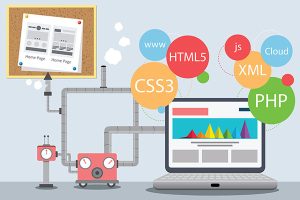
Information gathering
The focus of the first step is to gather all the necessary information for the project. As a design team, We ask relevant questions to go deeper into your business needs. Carefully analyze the client’s requirements, define the website purpose, and determine the goals of the website. The most popular targets are information sharing and money-making, or both of them. Our team has to think about how business goals can be reached with the aid of a good website.
Using the information gathered from phase one, it is time to put it together and make a detailed website plan. At this point, a site map is developed. The site map is the list of all main topic areas of the website, including sub-topics, if applicable. This map will clarify what content will be on the website and will help to understand the navigational structure. The future customers are end-users of the website — their journey has to be as simple as possible. The basis of an easy-to-navigate website is an excellent user interface.
Graphical design:
As a part of the design process, it is essential to carefully and tastefully apply such visual elements as the logo and brand colors, to strengthen the brand identity on the website. During the design phase, the team usually creates one or more prototypes for the website. A prototype is typically a static image, which represents the final look of the website. A good idea is to create clickable prototypes to help the client feel the website before development begins.
Development/build: At this point, the design itself should be ready. But it is usually in the form of static images. It requires extra development effort to translate it into HTML/CSS, and then to add a layer of animations or JavaScript, depending on the complexity of the design.
First, the homepage is developed, followed by a “shell” for the interior pages. The shell serves as a template for the content pages of the website, as it contains the main menu for the website. After this shell has been created, the task of the design team is to populate internal pages with content.
During this phase, elements such as interactive contact forms and e-commerce shopping carts should be implemented and made functional.
Testing:
When the content and the visuals are in place, the testing process can be started. Every page has to be tested to make sure that all links are working and the website is displayed correctly in different browsers. Even the word order in titles and descriptions has an impact on the webpage performance in various search engines. Later, when you have some traffic on your website, you can apply A/B testing techniques to find the optimal combination.
Delivery and launch:
Once we get final approval from the client, it is time for the website to go live. But before that, the site should be a run-through for the last time to confirm that all files have been uploaded correctly, and that the site is fully functional. Besides, the website domain name should be registered, and web hosting accounts set up.
Maintenance:
Once the website is live, some regular maintenance is usually required. User testing can be run on new content and features over and over to improve the usability and discoverability of features. This all can lead to new design and development tasks.
Binarique - All Rights Reserved.